 |
 |
Tuesday, March 10, 2020


UDOH News Release: Utah Health Officials Announce Second Case of COVID-19
 For Immediate Release
March 10, 2020
Media Contact:
COVID-19 Media Line
385-429-0015
Utah Health Officials Announce Second Case of COVID-19
(Salt Lake City, UT) – The Utah Department of Health (UDOH) and the Weber-Morgan Health Department (WMHD) today announced the state’s second case of COVID-19.
The patient resides within the Weber-Morgan health district, is older than 60, and is currently in serious, but stable, condition at Intermountain McKay Dee Hospital. Prior to becoming ill, the patient traveled extensively outside Utah and the U.S. and is believed to have been exposed to COVID-19 during those travels.
The UDOH and the WMHD are working to identify and contact anyone who may have been in close contact with the confirmed case. These individuals will be monitored by public health for fever and respiratory symptoms.
UDOH State Epidemiologist Dr. Angela Dunn will be available for interviews at 9:30 at the Cannon Health Building, room 129.
The patient’s sample was tested by the Utah Public Health Laboratory and is considered to be a “presumptive positive.” The Centers for Disease Control and Prevention will conduct further confirmatory testing.
The symptoms of COVID-19 are similar to what someone may be experiencing as the result of seasonal influenza – namely a fever, cough, or shortness of breath. These symptoms on their own are not worrisome and should not cause alarm. But if someone exhibits these symptoms who has recently traveled to areas with widespread COVID-19 illness or has been in close contact with a known positive case, that individual should immediately notify their health care provider, who will coordinate with the appropriate public health officials to determine next steps.
There is currently no vaccine or antiviral treatment available for coronavirus and it is flu and respiratory disease season. The UDOH recommends getting vaccinated for influenza, and taking everyday preventive actions to stop the spread of germs including regular hand washing, covering coughs and sneezes with a tissue or an elbow, and staying home when you’re sick. All nonessential travel to areas affected by COVID-19 is also discouraged.
More information about novel coronavirus can be found at coronavirus.utah.gov or at cdc.gov/coronavirus.
The patient resides within the Weber-Morgan health district, is older than 60, and is currently in serious, but stable, condition at Intermountain McKay Dee Hospital. Prior to becoming ill, the patient traveled extensively outside Utah and the U.S. and is believed to have been exposed to COVID-19 during those travels.
The UDOH and the WMHD are working to identify and contact anyone who may have been in close contact with the confirmed case. These individuals will be monitored by public health for fever and respiratory symptoms.
UDOH State Epidemiologist Dr. Angela Dunn will be available for interviews at 9:30 at the Cannon Health Building, room 129.
The patient’s sample was tested by the Utah Public Health Laboratory and is considered to be a “presumptive positive.” The Centers for Disease Control and Prevention will conduct further confirmatory testing.
The symptoms of COVID-19 are similar to what someone may be experiencing as the result of seasonal influenza – namely a fever, cough, or shortness of breath. These symptoms on their own are not worrisome and should not cause alarm. But if someone exhibits these symptoms who has recently traveled to areas with widespread COVID-19 illness or has been in close contact with a known positive case, that individual should immediately notify their health care provider, who will coordinate with the appropriate public health officials to determine next steps.
There is currently no vaccine or antiviral treatment available for coronavirus and it is flu and respiratory disease season. The UDOH recommends getting vaccinated for influenza, and taking everyday preventive actions to stop the spread of germs including regular hand washing, covering coughs and sneezes with a tissue or an elbow, and staying home when you’re sick. All nonessential travel to areas affected by COVID-19 is also discouraged.
More information about novel coronavirus can be found at coronavirus.utah.gov or at cdc.gov/coronavirus.
# # #
Coronavirus Employer Information Session
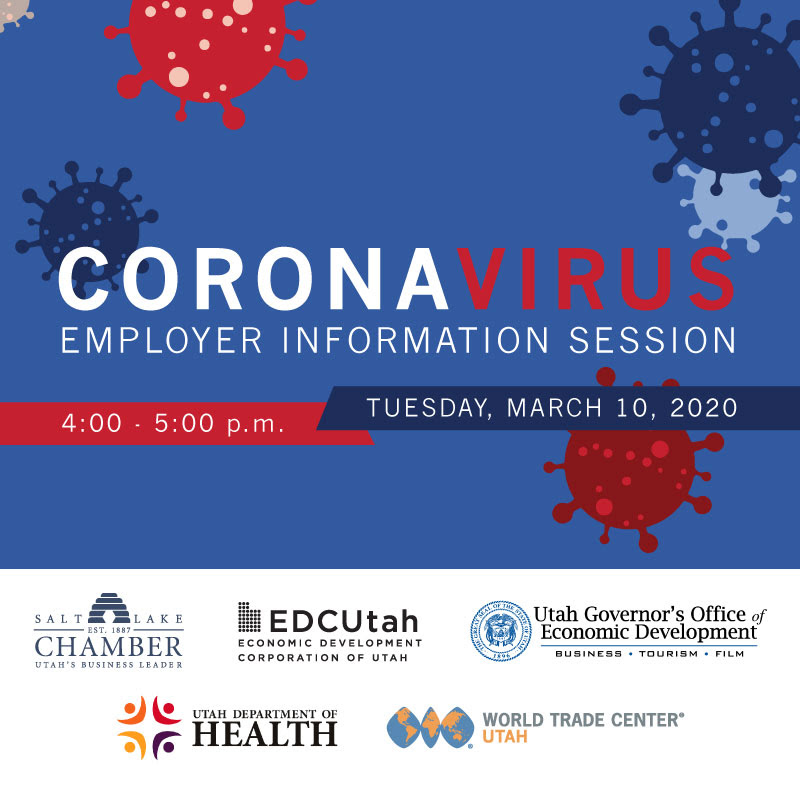
Employers, are you concerned about the coronavirus (COVID-19) and how it may impact your business?
Join us for a YouTube Live webcast where we’ll share information about protective measures you can take in the workplace.
Lt. Gov. Spencer Cox will lead the session and Dr. Angela Dunn, state epidemiologist from the Utah Department of Health, will address the outbreak, provide information and recommendations for Utah businesses.
The Utah Department of Health is monitoring the ongoing outbreak of novel (new) coronavirus that began in China and has subsequently spread to other countries. Utah employers may be concerned about the current situation, especially if they conduct business in mainland China or have employees or clients who have visited areas where the illness is widespread.
When: Tuesday, March 10, 2020, from 4:00 to 5:00 p.m.
Where: The public is invited to watch the YouTube Live video stream at utahgoed.info/coronavirus. The recorded session will be available at the same URL immediately following the live video stream.
Speakers
Join us for a YouTube Live webcast where we’ll share information about protective measures you can take in the workplace.
Lt. Gov. Spencer Cox will lead the session and Dr. Angela Dunn, state epidemiologist from the Utah Department of Health, will address the outbreak, provide information and recommendations for Utah businesses.
The Utah Department of Health is monitoring the ongoing outbreak of novel (new) coronavirus that began in China and has subsequently spread to other countries. Utah employers may be concerned about the current situation, especially if they conduct business in mainland China or have employees or clients who have visited areas where the illness is widespread.
When: Tuesday, March 10, 2020, from 4:00 to 5:00 p.m.
Where: The public is invited to watch the YouTube Live video stream at utahgoed.info/coronavirus. The recorded session will be available at the same URL immediately following the live video stream.
Speakers
- Lt. Gov. Spencer Cox
- Dr. Angela Dunn, state epidemiologist, Utah Department of Health
- Val Hale, GOED executive director
- Miles Hansen, president and CEO, World Trade Center Utah
Monday, March 9, 2020
Utah Community Action’s FREE HEAT Program is now year-round!
 Utah Community Action’s FREE HEAT Program is now year-round!
Struggling with your power and gas bills? Utah Community Action’s HEAT program provides free utility assistance and budget counseling to residents of Salt Lake County at or below 150% of the Federal Poverty Guidelines.
Learn more, apply online, or call 801-521-6107.
National Women and Girls HIV/AIDS Awareness Day
National Women and Girls HIV/AIDS Awareness Day, HIV Prevention Starts with Me: Ending the HIV Epidemic Together
The HHS Office of Women's Health (OWH) recognizes March 10 as National Women and Girls HIV/AIDS Awareness Day in order to raise awareness about the need for all women, especially pregnant women, to be tested and treated for HIV.
For information and resources, please visit OWH, the Centers for Disease Control and Prevention (CDC) and HIV.gov.
Find an HIV testing site with GetTested.
For information and resources, please visit OWH, the Centers for Disease Control and Prevention (CDC) and HIV.gov.
Find an HIV testing site with GetTested.
HHS Finalizes Historic Rules to Provide Patients More Control of Their Health Data
|

Thursday, March 5, 2020
Coronavirus – Latest Information
Current Situation
 The Utah Department of Health is actively monitoring an outbreak caused by a novel (new) coronavirus (COVID-19) first identified in Wuhan, Hubei Province, China. This outbreak began in early December 2019 and continues to expand in China and other countries.
NO CASES HAVE BEEN CONFIRMED IN UTAH. Only cases diagnosed in Utah will be counted as Utah cases. Although, the UDOH has investigated, and ruled out, several potential cases. Utah’s disease surveillance system is working as designed, as public health officials and health care providers are coordinating to identify and investigate potential cases.
While the origin of this particular outbreak can be traced back to China, it would be grossly inappropriate, not to mention medically ineffective, to ostracize anyone from our communities or exclude anyone from our places of public gathering based on their race, nationality, or ethnicity.
Many rumors related to COVID-19 circulating on social media are false or contain misinformation. People should be skeptical of rumors they hear on social media that aren’t being reported by reputable health organizations or mainstream media outlets and should not share or repost items unless they are able to confirm that they are true. False and inaccurate social media posts can cause a great deal of harm.
Even though this is a worrisome public health situation, the immediate health risk from COVID-19 to the general public is believed to be low. We can all contribute to a healthy community, and we appreciate your willingness to help protect the public health in Utah.
What’s Happening in Utah
The Utah Department of Health is working with local health departments, healthcare providers, and other public health partners throughout the state to monitor illness associated with this new coronavirus and to prevent further spread.
The Department has activated its Incident Command System in order to ensure effective communication and coordination with all involved agencies.
While there are currently no confirmed cases in Utah, the UDOH will actively track potential cases as they occur in Utah and will reach out to local health departments and clinicians for assistance to determine the scope of this outbreak and provide technical assistance as necessary.
What’s Happening Nationally
Cases of COVID-19 infection in travelers have been detected in the U.S. Person-to-person spread of COVID-19 also has been seen among close contacts of returned travelers from Wuhan, but at this time, this virus is NOT currently spreading in the community in the United States.
Currently, passenger screening is ongoing at airports where most travelers returning from China enter the country. The CDC is working with the Federal Aviation Administration to expand entry health screening for travelers from Wuhan, China.
Public health entry screening is part of a layered approach that, when used with other public health measures already in place to detect ill arriving travelers, can slow and reduce the spread of disease into the United States.
Public health entry screening alone is not a guarantee against the possible importation of this new virus, but is an important public health tool during this period of uncertainty and part of a multilayered response strategy.
Travel into and out of Wuhan, China has been restricted. The number of travelers coming into the U.S. should decline and further reduce the potential for spread of illness.
Subscribe to:
Posts (Atom)