 The Sandwich Generation: Working and Caring for Family Members
| ||
 | ||
 |
 |
Wednesday, January 4, 2017
The Sandwich Generation: Working and Caring for Family Members


Wednesday, December 28, 2016
Centers for Teen Pregnancy Prevention and Adolescent Health Promotion Research
The goal of this FOA is to fund organizations to conduct, synthesize and translate research into practice for the prevention of teen pregnancy and promotion of adolescent health and in support of OAH’s priorities and mission. Funded organizations will evaluate or assess best practices or evidence-based/evidence-
· Letters of Intent – Due January 31, 2017
· Applications – Due March 24, 2017
· Technical Assistance Webinar for Potential Applicants – Tuesday, January 24 from 1:00-2:30pm ET
o Call-in number: 1-888-566-7605, passcode 2340964
Support for Expectant and Parenting Teens, Women, Fathers, and Their Families
The goal of this FOA is to fund States and Tribes for the development and implementation of programs for expectant and parenting teens, women, fathers, and their families to improve health and related educational, social, and economic outcomes. Funded grants will provide an integrated and seamless network of supportive services in multiple primary settings: high schools, community service centers, and Institutions of Higher Education (IHE). OAH anticipates funding up to 20 grants with an annual budget of $500,000 - $1,500,000 for a three-year project period. To learn more, please visit the Open Grants page of the OAH website, or view the announcement on Grants.gov.
· Letters of Intent – Due January 31, 2017
· Applications – Due March 24, 2017
· Technical Assistance Webinar for Potential Applicants – Thursday, January 19, 2017 from 3:00-5:00pm ET
o Call-in number: 1-800-857-4868, passcode 7877854
Wednesday, December 21, 2016
Utah Leads States in ACA Signups
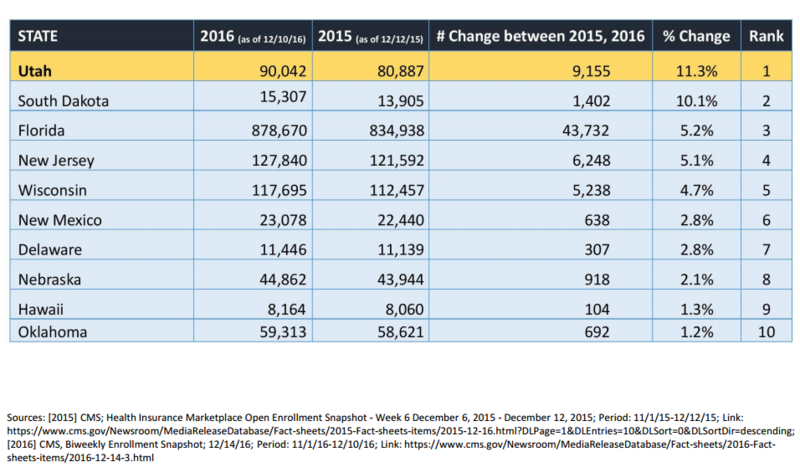
So far, Utah is at the top of the list for enrollees.
Ninety thousand forty-two. That’s the number of people in Utah who signed up for insurance under the ACA so far this year. In fact, it represents the biggest increase of people enrolling of any state in the country, according to the Utah Health Policy Project.
"We’re trying to figure out why so many Utahns are signing up this year when there’s so much turmoil and uncertainty this year," says Jason Stevenson.
Stevenson works with the Salt Lake City group that helps sign residents up for insurance.
The most likely reason, of course, is that some Utahns are trying to make sure they have insurance before the incoming Trump Administration and a Republican controlled Congress consider a possible repeal of the Affordable Care Act.
Stevenson also has another theory about the increase. With Utah having the highest percentage of kids signed up for the ACA of any state in the country, he believes parents are trying to make sure their families are covered before open enrollment ends.
"They’re being proactive, they’re signing up early and they’re locking in their insurance for 2017," Stevenson says.
With a little over a month left before the final sign up date for a 2017 health plan, Stevenson expects the trend to continue. In the meantime, Governor Herbert and Utah Insurance Commissioner Todd Kiser have started working with Congress to lay out what they hope to keep from the health care law and what they plan to cut.
Understanding the Health Status of American Indians/Alaska Natives

New HHS Office of Minority Health and CDC Collaboration to Improve Understanding of the Health Status of American Indians and Alaska Natives
A new Intra-Agency agreement between the HHS Office of Minority Health (OMH) and the Centers for Disease Control and Prevention (CDC) will enhance a behavioral risk factor surveillance survey (BRFSS) to provide an improved understanding of the health status of American Indian and Alaska Native (AI/AN) communities. As part of the CDC’s 2017 Behavioral Risk Factor Surveillance System, the CDC will conduct an oversampling in 11 states that have a higher proportion of American Indians and Alaska Natives (AI/AN).
The oversampling of AI/AN communities will increase understanding of health-related risk behaviors, chronic health conditions, access to care and use of preventive services in the AI/AN population. Because of small sample sizes among American Indians and Alaska Natives, this information has typically been omitted from reports citing national health statistics. Data from the BRFSS oversample of American Indians and Alaska Natives will help public health officials tailor health promotion activities in these communities to achieve health equity. The survey is expected to be launched in early 2017.
Youth Risk Behavior Survey – Youth Online Update Released
 Today, the Division of Adolescent and School Health (DASH) released an updated version of Youth Online - a user-friendly data access application that allows you to view and analyze Youth Risk Behavior Survey data from1991 – 2015. Youth Online now contains national, state, and local data on two aspects of sexual orientation - sexual identity and sex of sexual contacts. Youth Online can be found at www.cdc.gov/yrbs.
YRBS Background:
The YRBS monitors six categories of priority health behaviors among high school students—behaviors that contribute to unintentional injuries and violence; tobacco use; alcohol and other drug use; sexual behaviors related to unintended pregnancy and sexually transmitted diseases, including HIV infection; unhealthy dietary behaviors; and physical inactivity—plus the prevalence of obesity and asthma.
| Access Youth Online |
For more information about YRBS:
- Web site: www.cdc.gov/healthyyouth/data/
yrbs - Phone: 1-800-CDC-INFO (1-800-232-4636)
- Email: nccddashinfo@cdc.gov
Tuesday, December 20, 2016

National Minority Health Month 2017 Theme
We are pleased to announce the theme for National Minority Health Month 2017:
Bridging Health Equity Across Communities!
Bridging Health Equity Across Communities!
 During National Minority Health Month, beginning April 1, 2017, the HHS Office of Minority Health will join with our partners in raising awareness about efforts across health, education, justice, housing, transportation and employment sectors to address the factors known as the social determinants of health – environmental, social and economic conditions that impact health. The HHS Office of Minority Health will continue to bridge efforts across the nation to help eliminate health disparities, accelerate health equity and build a stronger, healthier nation.
Visit the OMH website to learn more about National Minority Health Month, and sign up for theNational Minority Health Month topic on our email list to be notified when we post new tools and resources to support your #NMHM17 events and programs!
Subscribe to:
Posts (Atom)