Total fruit consumption increased by 12 percent among children ages 2-18 between 2003 and 2010, though vegetable consumption remained unchanged, according to a study released last week by the Centers for Disease Control and Prevention (CDC). The study analyzed data from the National Health and Nutrition Examination Surveys; researchers concluded that no demographic group within this age range is meeting the Healthy People 2020 target for vegetables, while only children ages 2-5 are meeting the goal for fruit.
RWJF.org
 |
 |
Wednesday, August 13, 2014


Monday, August 11, 2014
Healthy Resources for Walking & Biking to School
Even though the Safe Routes to School movement has gained
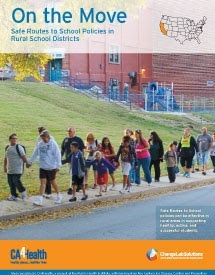 momentum nationwide, many communities still face challenges implementing these programs. Four new publications from ChangeLab Solutions are now available to help districts, parents, and active transportation advocates develop policies for walking or bicycling to school.
On the Move and Get Out & Get Moving are geared toward rural areas that face unique challenges around implementing Safe Routes to School programs. On the Move breaks down approaches and tools of particular interest to rural school districts, including highlights of the online Safe Routes to School Policy Workbook tool.Get Out & Get Moving explores the legal implications of remote drop-off programs, and includes a cost-benefit worksheet for assessing risk.
 Incorporating Safe Routes to School into Local School Wellness Policies and Model General Plan Language Supporting Safe Routes to Schools provide model language that communities can adapt to their specific needs.
These publications—in conjunction with the Safe Routes to School Policy Workbook and our other Safe Routes to School resources—can help create environments that will improve health outcomes for children. For more information on implementing Safe Routes to School policies in your community, please contact us.
momentum nationwide, many communities still face challenges implementing these programs. Four new publications from ChangeLab Solutions are now available to help districts, parents, and active transportation advocates develop policies for walking or bicycling to school.On the Move and Get Out & Get Moving are geared toward rural areas that face unique challenges around implementing Safe Routes to School programs. On the Move breaks down approaches and tools of particular interest to rural school districts, including highlights of the online Safe Routes to School Policy Workbook tool.Get Out & Get Moving explores the legal implications of remote drop-off programs, and includes a cost-benefit worksheet for assessing risk.
Incorporating Safe Routes to School into Local School Wellness Policies and Model General Plan Language Supporting Safe Routes to Schools provide model language that communities can adapt to their specific needs.These publications—in conjunction with the Safe Routes to School Policy Workbook and our other Safe Routes to School resources—can help create environments that will improve health outcomes for children. For more information on implementing Safe Routes to School policies in your community, please contact us.
Thursday, August 7, 2014
Interval Training While Walking Helps Control Blood Sugar
Lots of high-performance athletes use interval training to maximize their fitness. From
runners to cyclists to boot-camp fanatics the strategy involves
alternating between periods of high intensity and lower intensity
aerobic training.
Now, a study published in the journal finds that may help the millions of people with Type 2 diabetes and prediabetes who are trying to control their blood sugar.

Taking an hour-long walk each day outdoors or on a treadmill. As part of the study, researchers enrolled about 30 volunteers with Type 2 diabetes who were in their late 50s and early 60s.
The volunteers were divided into groups. One group was instructed to walk three minutes briskly, followed by three minutes at a more restful pace, and repeat that process for an hour.
Another group walked at a continuous pace for the same amount of time.
A third group, a control group, kept up their normal routines, which didn't include daily exercise.
"What we expected to see ... was that both exercising groups would have an improvement in their glucose [or blood sugar] control," says study author , an associate professor at the University of Copenhagen who studies how exercise affects glycemic control.
But that's not what happened.
The interval walkers did improve. Their glucose disposal — the ability to move sugar out of the circulating blood stream and into parts of the body where it can be used as fuel — improved by 20 percent compared to the non-exercising group. And their hemoglobin , a longer-term measure of blood sugar, dipped slightly too.
But the steady paced walkers saw no improvement at all.
"This was somewhat surprising considering, that they were doing one hour of exercising a day for four months" says Solomon.
So what explains the benefits of interval walking? It's not exactly clear, but there's a leading theory.
"It's this switch between the intensities that we think is critical here," says Solomon. "You're able to work hard, and then rest hard ... rather than just walking at a fixed pace." And during the high-intensity bursts, your muscles need more fuel in the form of glucose.
"It makes sense that intervals would help people with blood sugar control," says , a professor of preventative medicine at the Pennington Biomedical Research Center in Baton Rouge, La. He explains that our muscles are the No.1 consumer of blood sugar in our bodies.
So, when we do things, such as short bursts of high-impact aerobic activity , "you're pulling excess sugar out of the blood, which results in healtier blood sugar levels," Church says.
This study is small, but the findings match other research on intervals, which find benefits that seem to go beyond better blood sugar.
"There are a number of studies that have shown that when you increase the intensity [of aerobic exercise] in the form of doing intervals, there's additional benefits beyond just the calories burned," Solomon says.
There are still unanswered questions, he adds, such as can interval walking cut the risk of strokes or other health problems that are associated with diabetes?
"We really need to understand how this has an impact on the long-term health of these patients with diabetes," Solomon says.
npr health blog
The volunteers were divided into groups. One group was instructed to walk three minutes briskly, followed by three minutes at a more restful pace, and repeat that process for an hour.
Another group walked at a continuous pace for the same amount of time.
A third group, a control group, kept up their normal routines, which didn't include daily exercise.
"What we expected to see ... was that both exercising groups would have an improvement in their glucose [or blood sugar] control," says study author , an associate professor at the University of Copenhagen who studies how exercise affects glycemic control.
But that's not what happened.
The interval walkers did improve. Their glucose disposal — the ability to move sugar out of the circulating blood stream and into parts of the body where it can be used as fuel — improved by 20 percent compared to the non-exercising group. And their hemoglobin , a longer-term measure of blood sugar, dipped slightly too.
But the steady paced walkers saw no improvement at all.
"This was somewhat surprising considering, that they were doing one hour of exercising a day for four months" says Solomon.
So what explains the benefits of interval walking? It's not exactly clear, but there's a leading theory.
"It's this switch between the intensities that we think is critical here," says Solomon. "You're able to work hard, and then rest hard ... rather than just walking at a fixed pace." And during the high-intensity bursts, your muscles need more fuel in the form of glucose.
"It makes sense that intervals would help people with blood sugar control," says , a professor of preventative medicine at the Pennington Biomedical Research Center in Baton Rouge, La. He explains that our muscles are the No.1 consumer of blood sugar in our bodies.
So, when we do things, such as short bursts of high-impact aerobic activity , "you're pulling excess sugar out of the blood, which results in healtier blood sugar levels," Church says.
This study is small, but the findings match other research on intervals, which find benefits that seem to go beyond better blood sugar.
"There are a number of studies that have shown that when you increase the intensity [of aerobic exercise] in the form of doing intervals, there's additional benefits beyond just the calories burned," Solomon says.
There are still unanswered questions, he adds, such as can interval walking cut the risk of strokes or other health problems that are associated with diabetes?
"We really need to understand how this has an impact on the long-term health of these patients with diabetes," Solomon says.
npr health blog
Funding Opportunity: Capacity Building Grant for Native Communities
The Notah Begay III Foundation's Native Strong: Healthy Kids, Healthy Futures has announced a new Capacity Building Grant Opportunity. "The purpose of Native Strong and the Capacity Building Grant is to address childhood obesity and type 2 diabetes in Native communities. These grants {up to $20,000} support Community Health Assessments to better understand the root causes of childhood obesity and type 2 diabetes resulting in strategies and an action plan to address this issue, and/or Community Planning and Capacity Building to create a community-driven action plan to address childhood obesity and type 2 diabetes." Deadline for applications is Friday, September 12th. An informational webinar is scheduled for Wednesday, August 13, 1:00 2:00 (EDT).
CODA (Council on Diversity Affairs) is looking for NEW members for the CODA Human Rights subcommittees
Goal - To Produce and support Actions/Strategies that support Human Rights and “Inclusion”
Meets the 1st Tuesday 12:00-1:00
North Building – 2nd Floor, N-2100 – Mayor’s Conference Room
The CODA Human Rights subcommittee meets one hour a month. As a subcommittee member you will be expected to participate in the subcommittee projects/events which could be an additional 5-8 hours every year. This is a volunteer subcommittee.
The Council on Diversity Affairs (CODA), created June 2005 by Salt Lake County Mayor Peter Corroon has inspired awareness and pride in the uniqueness and diversity possessed by the residents of Salt Lake County. We are not a county of “this” group and “that” group but rather a community that embraces and welcomes all of us as one community. A familiar phrase in CODA is “Diversity, It’s about ALL of us
If you are interested please send an email to Rebecca Sanchez, RLSanchez@slco.org stating your experience and why you would like to join the subcommittee.
Tuesday, August 5, 2014
Multicultural Youth Leadership Summit
This one-day program will bring together 1,500 students along with parents, educators, community and government leaders for a series of presentations and break-out sessions to encourage youth to become leaders in their communities and to keep themselves and their peers on track to reach their educational goals.
Join us in working together to engage, support and invest in our youth!
More information will be provided in the coming weeks. If you have any questions please do not hesitate to contact us at (801) 245-7214 or jhor@utah.gov.
Monday, August 4, 2014
CDC Releases Breastfeeding Report Card 2014
Breastfeeding rates continue to rise in the United States. In 2011, 79% of newborn infants started to breastfeed. Yet breastfeeding did not continue for as long as recommended. Of infants born in 2011, 49% were breastfeeding at 6 months and 27% at 12 months. Professional lactation support can help mothers initiate and continue breastfeeding. The Report Card has been used to track the number of International Board Certified Lactation Consultants (IBCLCs) per 1,000 live births since 2006. This year’s Report Card also includes the number of Certified Lactation Counselors (CLCs) per 1,000 live births.
Breastfeeding, with its many known health benefits for infants, children, and mothers, is a key strategy to accomplish this goal. There are many ways that communities can support breastfeeding mothers and babies, and everyone plays a role. The CDC Breastfeeding Report Card provides information on breastfeeding practices and supports in all states. Public health practitioners can use the Report Card to monitor progress, celebrate success, and identify opportunities to work with health professionals and community members.
Read entire report at 2014 Breastfeeding Report Card
Breastfeeding, with its many known health benefits for infants, children, and mothers, is a key strategy to accomplish this goal. There are many ways that communities can support breastfeeding mothers and babies, and everyone plays a role. The CDC Breastfeeding Report Card provides information on breastfeeding practices and supports in all states. Public health practitioners can use the Report Card to monitor progress, celebrate success, and identify opportunities to work with health professionals and community members.
Read entire report at 2014 Breastfeeding Report Card
Subscribe to:
Posts (Atom)